The Digital Euro: What's Confirmed, What's Undecided, and What's Just Wrong
The digital euro explained without the panic: what the ECB has actually committed to, what's still open, and which viral claims are simply false.
The digital euro is a public, electronic version of cash that the European Central Bank hopes to issue in 2029 — not next year, and not at all unless EU legislators pass the law first. It is designed to sit alongside notes and coins rather than replace them, it would be free for basic personal use, and the ECB has stated it will not be able to connect any transaction to a private individual.
Almost everything else you've read about it falls into one of two categories: genuinely undecided, or simply untrue. This article sorts which is which, and I've kept to what the ECB has actually published rather than what people say it means.
The three-column version
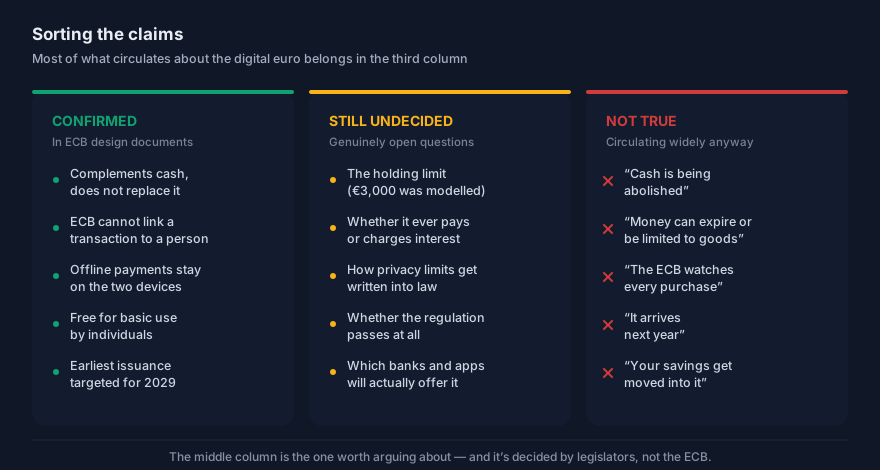
The middle column is the one worth paying attention to, and it's the one nobody argues about — because arguing about the third column is more fun.
The timeline is longer than people think
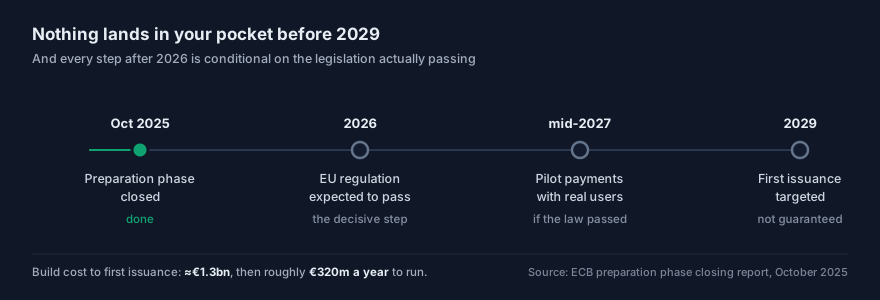
The ECB closed its preparation phase in October 2025 and moved into building technical capacity. The working assumption is that the regulation is adopted during 2026, pilots begin around mid-2027, and first issuance happens during 2029.
Every one of those steps is conditional. The ECB cannot issue a digital euro on its own authority — it needs the Regulation, and that sits with the European Parliament and Council. If the law stalls, the timeline stalls with it.
For scale: building it is costed at around €1.3 billion up to first issuance, with roughly €320 million a year to operate. Whether that's money well spent is a fair argument to have. It's a different argument from the ones usually being had.
The privacy question, answered properly
This is where most coverage goes wrong, because it compares the digital euro to cash. That's the wrong comparison. The right one is against the card in your pocket.
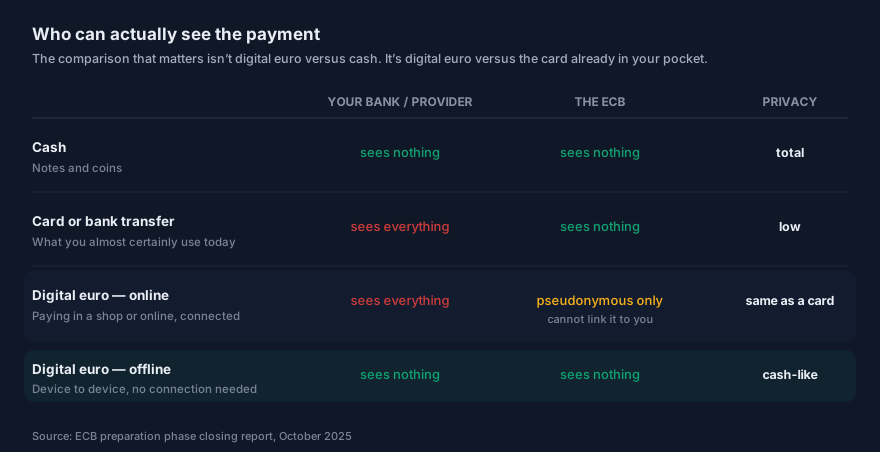
Right now, when you tap a card, your bank sees the merchant, the amount, the time and the location, and keeps that record for years. That's the baseline you already live with.
Under the ECB's published design, a digital euro payment works like this. Your payment provider — a bank or an app — processes the transaction and sees it, exactly as now. The Eurosystem receives only pseudonymous identifiers. In the ECB's own words, it "will not be able to connect any transaction with a private individual."
Offline is the more interesting case. Paying device-to-device without a connection means the transaction details "remain on the devices and are not shared with PSPs or the Eurosystem during (or after) the payment process." Nobody sees it. That is genuinely closer to cash than anything you can do with a card today.
So the honest summary: online, it's about as private as your current card. Offline, it's considerably more private. The claim that it hands the ECB a live feed of your shopping is not supported by anything the ECB has published.
Where scepticism is warranted: these are design commitments and press statements. They are not yet law. Which brings us to the part that actually deserves attention.
"Programmable money" — the claim that's half right
This is the most persistent fear, and it's worth being precise rather than dismissive, because the wording matters and both sides have been sloppy with it.
Programmable money would mean the currency itself carries rules: euros that expire if unspent, or that can't be used on certain goods. Christine Lagarde has been direct about this — "a euro is a euro whether it is digital or cash, it cannot be programmable." Programmable payments are different, and they are in scope. That means you set a condition on a payment: release funds when the goods arrive, or pay this bill automatically on the 1st. Lagarde's own framing is that a digital euro "can be associated with conditionalities, which is different, but not programmable." The ECB's closing report confirms it has tested conditional payments — fund reservations and similar mechanisms.So: the technology permits conditions to be attached to payments. The stated policy is that only the user attaches them, never the state.
That distinction is real, and it is also exactly the kind of distinction that can erode. The sensible position isn't "it's a conspiracy" and it isn't "trust us" — it's that the protection belongs in the Regulation's text, not in a speech. If you care about this, the thing to follow is the legislative wording during 2026, not the ECB's press releases. That is a legitimate thing to pay attention to, and it's a more useful use of the worry than the viral version.
What actually changes for you
Realistically, in 2029, if everything proceeds: you would get an additional payment option in your existing banking app, or in an ECB-provided one. It would be free for basic personal use. It would work offline, which no card does. And there would be a cap on how much you can hold — the ECB modelled up to €3,000 per person for its financial-stability analysis, though the final figure isn't set. For the change to euro transfers that has already arrived, see the no-match warning on bank transfers.
That cap tells you what this is. A holding limit of a few thousand euros makes the digital euro a payment instrument, not a savings account. It also disposes of the "they'll move your savings into it and charge negative rates" claim: you can't hold savings in a thing capped at €3,000, and nobody is moving your deposits anywhere without your instruction.
Day to day, the honest answer is that for most people it changes very little. It's another way to pay, with better offline behaviour and a public issuer instead of a card network. The strategic reasons the EU wants it — reducing dependence on Visa, Mastercard and non-European payment infrastructure — matter more at the level of the currency than at the level of your wallet.
Frequently asked questions
Will the digital euro replace cash?
No. The ECB's design documents state that the digital euro is intended to complement physical cash and to preserve freedom of choice in how people pay. Cash's legal tender status is not being removed by this project.
Whether cash usage keeps declining is a separate question, and it's been declining for years for reasons that have nothing to do with the digital euro. But "declining because people choose cards" and "abolished by the ECB" are different things, and only the first is happening.
Can the digital euro be programmed to expire or restrict what I buy?
Not under the stated design. The ECB distinguishes programmable money — currency carrying built-in restrictions, which it says will not exist — from programmable payments, where the user sets conditions such as paying on delivery. Lagarde has stated plainly that a euro "cannot be programmable."
The fair caveat is that this is a policy commitment rather than an enacted legal guarantee, so the wording of the 2026 Regulation is what will make it binding. Watching that is reasonable. Assuming the worst as settled fact is not.
Will the ECB be able to see everything I buy?
No. Under the published design, the ECB receives only pseudonymous identifiers and has stated it will not be able to connect any transaction with a private individual. Your payment provider sees the transaction — exactly as your bank does today with a card.
Offline payments go further: the details stay on the two devices and are never shared with the provider or the Eurosystem at all.
How much digital euro will I be allowed to hold?
The limit isn't finalised. The ECB used a hypothetical ceiling of up to €3,000 per person when modelling the effect on bank deposits, and EU finance ministers have agreed a framework putting limits in the low thousands.
The purpose is financial stability: without a cap, people could shift large deposits out of commercial banks during a crisis, which would make bank runs faster rather than slower.
When will I actually be able to use it?
2029 at the earliest, and only if the EU regulation is adopted during 2026 and pilots run successfully from around mid-2027. There is no scenario in which it appears in your banking app next year.
If you see a message urging you to sign up for the digital euro, or to move money in advance of it, that is a scam. There is nothing to sign up for, and there won't be for years.
The part worth your attention
The digital euro is neither the surveillance apparatus of the viral posts nor the transformation its advocates describe. On current design it's a public payment option with better offline privacy than a card and a cap that keeps it from being a savings vehicle.
The genuinely open questions — the holding limit, whether the privacy guarantees get written into binding law, whether it passes at all — get decided by legislators during 2026. That's where scrutiny is worth spending, and it's the one part of this story that isn't already settled.
In the meantime, the thing that determines your financial position is still the boring stuff: what comes in, what goes out, and whether you know which is which.
Sources
- ECB — Digital euro preparation phase, closing report (October 2025)
- ECB — Progress on the digital euro
- Banque de France — Eurosystem moving to next phase of digital euro project
- ECB — Digital euro: an opportunity for banks
- ECB — Europe's money evolves so people's freedom to pay remains
- Lagarde on programmability and conditionalities
I build Portofelo, an offline-first expense tracker for iPhone. I've spent more hours than I'd like to admit inside other people's budgeting apps, and I write about what actually works.
All articles by Elena Marek →Related articles
Start tracking your finances today
Portofelo makes budgeting and expense tracking effortless. Free to download.
Get Portofelo Free